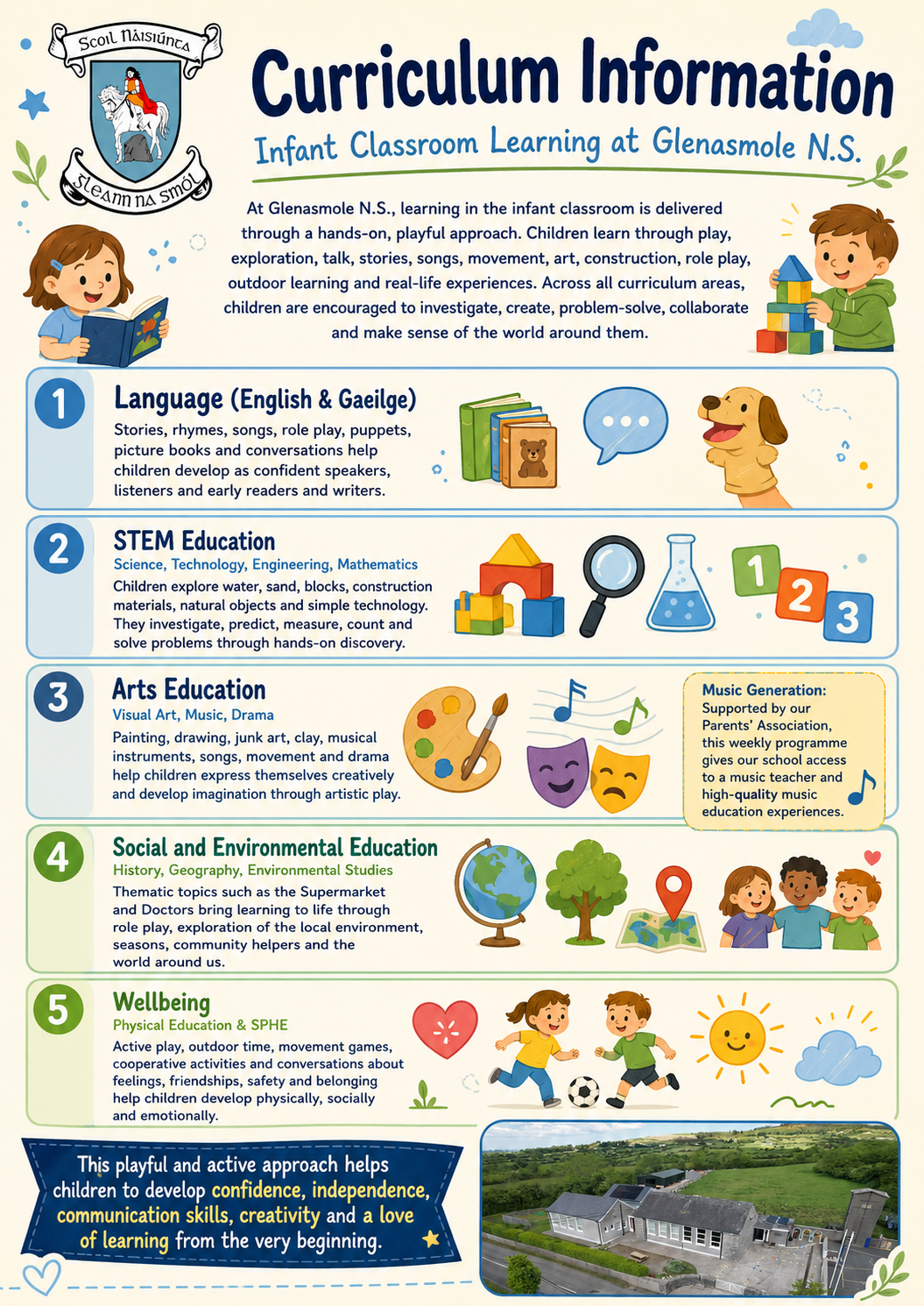
In Junior and Senior Infants, children learn best through active, playful and meaningful experiences. At Glenasmole N.S., learning in the infant classroom is practical, creative and child centred.
Children learn through play, exploration, talk, stories, songs, movement, art, construction, role play, outdoor learning and real life experiences.
Across all areas of the curriculum, children are encouraged to investigate, create, problem solve, collaborate and make sense of the world around them.
How Our Infants Learn
Language and Literacy
Children develop early language, reading and writing skills through stories, rhymes, songs, role play, puppets, picture books and conversation.
In Junior Infants, children begin learning phonics through Jolly Phonics. They learn the sounds made by letters and groups of letters, and gradually begin to blend these sounds together to read words. They also learn tricky words, which are words that cannot always be sounded out easily.
Children are supported to become confident speakers, careful listeners and early readers and writers in both English and Gaeilge.
Handwriting
Children develop early handwriting skills through fine motor activities, pencil control, letter formation and lots of practice in a supportive way.
Activities such as cutting, threading, playdough, colouring, tracing and mark making all help children build the hand strength and coordination needed for writing.
Early Maths and STEM
Mathematical learning in the infant classroom is active and hands on. Children count, sort, match, compare, measure, build and solve problems using real objects and playful activities.
Programmes such as Ready, Set, Go Maths help children develop a strong understanding of number, sorting, relationships, operations, counting, recognition and early problem solving.
STEM learning is also part of infant life. Children explore water, sand, blocks, construction materials, natural objects and simple technology. They investigate, predict, test ideas, measure, count and solve problems through discovery and play.
Creative Arts
The arts are an important part of infant learning. Children express themselves through painting, drawing, junk art, clay, music, songs, movement and drama.
Creative activities help children develop imagination, confidence, communication skills and self expression.
Our Parents’ Association also supports music opportunities in the school, helping children to access high quality music learning and performance experiences.
Social and Environmental Learning
Children learn about the world around them through themes such as the supermarket, the doctor, homes, animals, seasons, people who help us and our local environment.
These topics bring learning to life through role play, stories, walks, nature exploration, discussion, art, play and discovery.
Wellbeing and Outdoor Learning
Wellbeing is central to infant learning. Children take part in active play, outdoor time, movement games, cooperative activities and conversations about feelings, friendships, safety and belonging.
Through these experiences, children develop confidence, independence, resilience, communication skills and positive relationships with others.